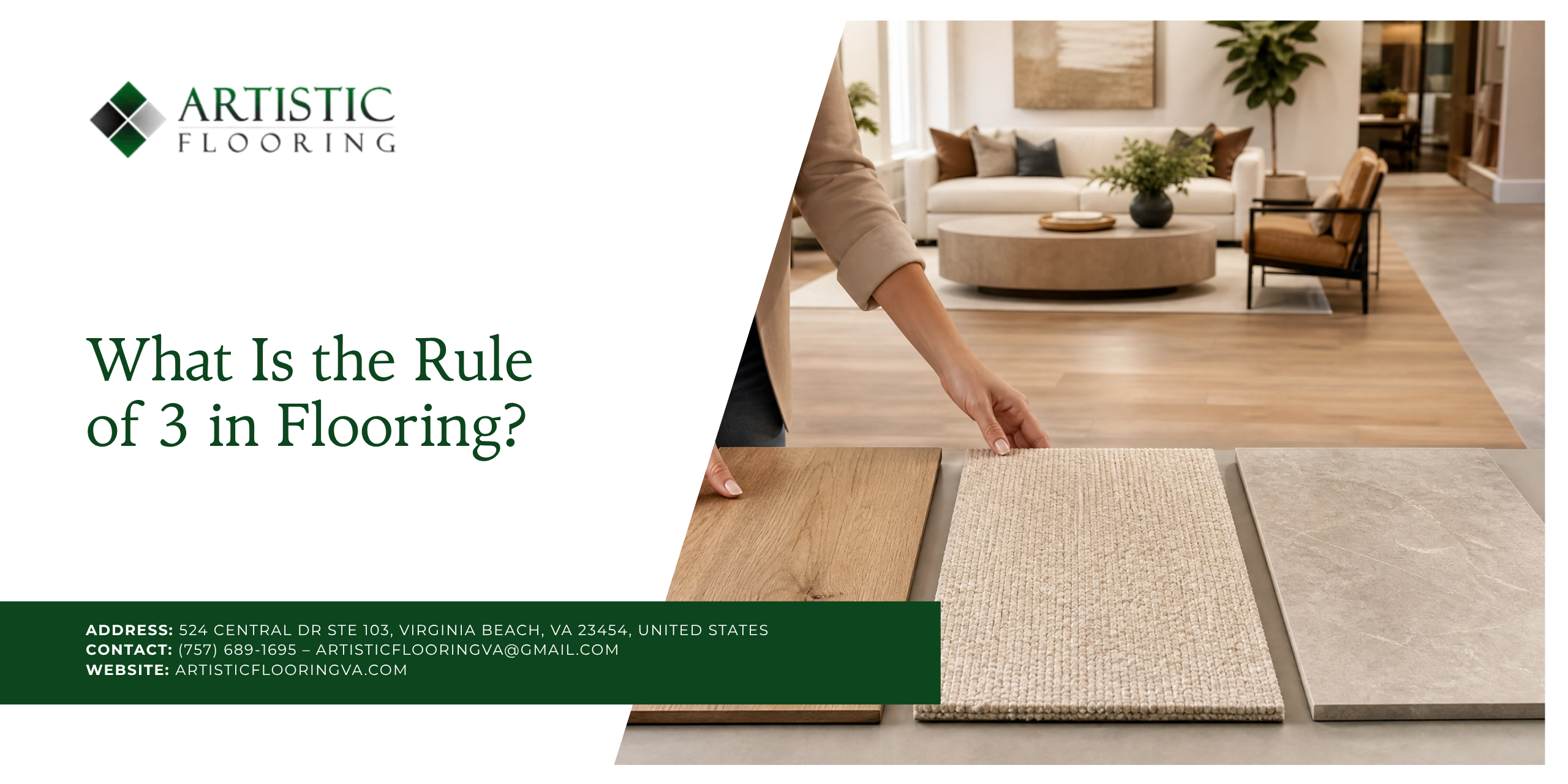
The rule of 3 in flooring says your home should have no more than three flooring elements, whether that means three materials, three tones of the same material, or three textures. It makes your home feel designed instead of pieced together. Pair it with the 60-30-10 distribution rule and you have a full whole-home flooring plan in one decision.
The rule of 3 in flooring is the fastest way to make a home feel designed rather than assembled. In 30+ years of installing floors across Virginia Beach, Norfolk, and Chesapeake, our team has watched this single principle separate the homes that feel polished from the ones that feel patched together. Three coordinated floors look intentional. Five look like five separate purchases. Here is how the rule works in 2026, where it breaks down, and how to use it in your own home.
Ready to see the rule of 3 in action?
Visit our Virginia Beach flooring showroom at 524 Central Dr to browse coordinated hardwood, luxury vinyl, and tile samples side by side. Book your free consultation here.
Table of Contents
ToggleWhat Is the Rule of 3 in Flooring, Exactly?
The rule of 3 in flooring says you should use no more than three different flooring elements in one home. That can mean three materials, three tones of the same material, or three textures. The principle works because the eye reads three as balanced and four as cluttered.
This is not a marketing gimmick. Interior designers and flooring pros have used the rule for decades because it solves a real problem. Most homeowners pick floors room by room instead of planning the whole house. By the time the project is done, they have ended up with five or six different floors that fight each other visually.
In our Virginia Beach showroom, we see this every week. A family arrives with eight Pinterest screenshots collected over six months. By the end of the consult, our team has them down to three coordinated options that match how they actually live.
The three slots can be filled in different ways:
- Three materials: hardwood, tile, and carpet
- Three tones: light, medium, and dark planks of the same wood species
- Three textures: smooth, hand-scraped, and plush
- Three finishes: matte, satin, and natural
You pick the version that fits your layout. In a smaller ranch in Kempsville, three tones of one material often beats three completely different products. In a larger home in Bay Colony or Thoroughgood with distinct wings, three materials by function is the cleaner call.
The point is not to follow the rule blindly. The point is to make one design decision for the whole house instead of six decisions room by room.
Why Does the Rule of 3 Work So Well in Homes?
The rule of 3 works because the human eye processes odd-numbered groupings as natural. Three points of interest feel balanced without being symmetrical. Five or more flooring choices overload the visual field and make a home feel smaller and busier than it really is.
There is real psychology behind this. Odd-numbered groupings show up in art, architecture, music, and storytelling for a reason. Three columns. Three-act structure. Three primary colors. The eye tracks three elements as a complete composition. Anything past that reads as clutter.
Here is what the rule of 3 actually fixes in a Virginia Beach home:
- Stops the patchwork look. A different floor in every room makes a home feel unfinished
- Makes spaces feel bigger. Coordinated floors visually expand open layouts common in Chic’s Beach and West Ocean View
- Simplifies maintenance. Three floors means three cleaning routines, not six
- Protects resale value. Virginia Beach buyers in 2026 notice flooring inconsistency immediately
- Removes decision fatigue. Once you commit to three, every remaining choice gets easier
- Future-proofs your design. Restrained palettes age better than trendy material mixes
The rule does not limit creativity. It protects your home from too many one-off choices that add up to visual noise.
How Do You Apply the Rule of 3 With Three Different Materials?
The most common way to apply the rule of 3 is to assign each material to a functional zone. Hardwood flooring in Virginia Beach living areas. Tile for wet zones. Carpet for bedrooms. Each material does the job its room demands without competing with the others.
Here is how a typical Virginia Beach home breaks down across three materials:
Material 1: Living Areas (roughly 60% of square footage) This is your hero floor. Living room, dining room, hallways, entryway, sometimes the kitchen. We usually recommend engineered hardwood or luxury vinyl plank here. Engineered hardwood for coastal homes handles the humidity swings that solid wood struggles with. Waterproof LVP, especially COREtec and similar products, holds up to sand, salt air, and the constant in-and-out traffic of beach life.
Material 2: Wet Zones (roughly 30% of square footage) Bathrooms, kitchen if you did not use hardwood there, laundry rooms, mudrooms. Porcelain tile dominates this slot. It handles standing water, steam, and splashes without warping or staining, and it lasts 50 or more years with basic care.
Material 3: Private Spaces (roughly 10% of square footage) Bedrooms, home office, finished basement. Plush carpet wins here because comfort matters more than durability. Carpet flooring in Virginia Beach homes, especially near the coast, works best in stain-resistant twist styles that handle sand and pet hair. Soft underfoot first thing in the morning is one of those small details that makes a home feel like home.
To keep three materials looking like a single plan, coordinate the undertones. If your hardwood is warm honey oak, your tile and carpet should carry warm undertones too. Mixing a cool gray tile with warm honey wood and beige carpet is the most common mistake we see across Norfolk and Chesapeake homes. The materials are fine individually. Together, they fight each other.
This is exactly why we send clients home with full-size samples. Light in our showroom is different from light in your living room at 5 PM in October. What coordinates under store lighting can look mismatched in your actual space.
Three Materials vs Three Tones vs Three Textures: Which Should You Choose?
| Approach | Best For | How It Reads | Coastal Virginia Beach Notes |
| Three Materials | Multi-zone homes with kitchens, baths, and bedrooms | Visually distinct floors per function | Pair engineered hardwood, porcelain tile, and twist carpet for humidity resilience |
| Three Tones | Open-concept layouts with continuous sightlines | Subtle variation within one product family | Works best with white oak or LVP with multiple stain options |
| Three Textures | Neutral palettes that feel flat | Layered tactile interest at similar color values | Hand-scraped hardwood hides sand and surface scratches near the beach |
| Three Finishes | Period homes with architectural character | Matte, satin, and natural finishes per room | Less common but works in historic Park Place and Oceanfront cottages |
Three tones works best when your materials are all hardwood or luxury vinyl plank, because both come in dozens of stain options from the same manufacturer. A family we worked with in Bay Colony ran white oak in three coordinated stains across their open layout: light planks in the main living area, medium-stained planks in the hallway, and a darker stain under the dining table to anchor that zone. Same width. Same brand. Same finish family. Three stains. The whole floor felt like one composition.
Three textures works best when your color palette is restrained and you want depth without competing tones. Polished tile, hand-scraped hardwood, and plush twist carpet is a classic example. The colors barely shift. The textures do all the work.
Honestly, three tones beats three materials in homes under 2,000 square feet most of the time. The smaller the home, the harder three completely different materials work against each other. Save the three-material approach for larger floor plans where you have natural breaks between zones.
What Is the 60-30-10 Rule and How Does It Work With the Rule of 3?
The 60-30-10 rule is a distribution principle that tells you not just which three materials to pick, but how much of each to install. Your dominant material should cover roughly 60% of your home, your secondary material 30%, and your accent material 10%.
Most online guides stop at “pick three materials.” Without a distribution framework, three materials still look jumbled. The 60-30-10 rule is what makes the whole plan click.
Here is what it looks like in a 2,000 sq ft Virginia Beach home:
| Material | Coverage | Square Footage | Typical Use |
| Hardwood or LVP (hero) | 60% | 1,200 sq ft | Living room, dining, hallways, main bedroom |
| Tile (secondary) | 30% | 600 sq ft | Kitchen, bathrooms, laundry, mudroom |
| Carpet (accent) | 10% | 200 sq ft | Guest bedroom or basement |
When the numbers go the other way, the home feels off. We have measured homes in Wards Corner and Lamberts Point where carpet ended up covering 50% of the square footage and hardwood only 20%. The home read as a 1990s build even with brand-new floors because the accent material became the hero.
A few rules our team uses when planning distribution:
- The hero floor goes in the most visible space, usually the living room and main hallway
- The secondary floor handles the hardest-working rooms, like kitchens and bathrooms
- The accent floor goes where comfort beats durability, mainly bedrooms
- Open sightlines should be 100% hero material so the home feels expansive
- Closed-door rooms can break the pattern because the door creates a natural visual break
When we walk a homeowner through this at our showroom, the lightbulb goes on within about ten minutes. Most homeowners have never been given a framework for how much of each material to use. Pairing the rule of 3 with the 60-30-10 rule gives you a whole-home plan in one conversation.
How to Plan a Rule of 3 Layout for Your Virginia Beach Home
Planning a rule of 3 layout starts with mapping your home into functional zones before you pick a single product. Most homeowners do it in reverse and end up with a patchwork. Map first, pick second.
Here is the step-by-step process our team walks every Virginia Beach client through:
- Map your home into three functional zones. Pull out your floor plan or sketch your home roughly to scale. Identify your living zones, wet zones, and private zones.
- Add up the square footage of each zone. The biggest zone gets your hero material. If your living zone is 60% of the home, your wet zone is 25%, and your private zone is 15%, you are already close to the right distribution.
- Pick your hero material based on lifestyle. Families with kids and pets in Salem or Indian River usually go with waterproof LVP options for coastal homes or engineered hardwood. Empty nesters in Bay Colony often choose solid hardwood for long-term value. Homeowners near Sandbridge lean toward waterproof LVP because of sand and humidity.
- Choose your wet-zone material. Porcelain tile is the default. It handles moisture, cleans easily, and lasts decades. Pick a tile that shares the undertone of your hero floor. Warm wood pairs with warm-toned tile. Cool gray wood pairs with cool gray tile.
- Choose your accent material. Carpet in bedrooms is the most common choice. Pick a tone that bridges your hero floor and your tile so all three feel connected.
- Test in your actual home before committing. Take full-size samples home. Lay them next to each other in morning, afternoon, and evening light. Virginia Beach’s coastal light shifts dramatically through the day. What coordinates at 10 AM can look mismatched at 6 PM.
- Plan transitions before installation. Decide where each material starts and ends before the first board goes down. The National Wood Flooring Association recommends planning all transitions in advance because mid-install adjustments rarely look right. We photograph the subfloor before every install so transitions land on structural break points, not guesswork.
When Should You Break the Rule of 3?
Most homes should follow the rule of 3 closely. The exceptions are large open-concept layouts, period homes with original architectural flooring, and multi-floor properties where the upper level is entirely private. Break the rule deliberately, never by accident.
The first exception is very open layouts. Homes with 3,000 or more square feet of mostly open space, like some of the newer builds in Cypress Point, can feel busy with three materials because there are no walls to break up the transitions. One or two materials often look cleaner in those cases.
The second exception is historic homes. Virginia Beach has older properties, especially cottages near the Oceanfront and brick homes in Thoroughgood, where original flooring defines the home’s character. If you have original wide-plank pine in the front parlor, you let the architecture lead and work around it.
The third exception is multi-floor homes where the upstairs is entirely private. If the second floor only contains bedrooms and one bathroom, you can run carpet throughout without worrying about the rule downstairs. The staircase acts as a natural visual break.
The fourth exception is deliberate contrast. A powder room with bold patterned tile or a sunroom with terracotta reads as a designer choice rather than a mistake, as long as it is clearly intentional and contained to one room.
The rule our team gives clients is simple: if you are going to break it, plan it.
Why Coastal Virginia Beach Demands a Smarter Approach
Coastal homes deal with humidity, salt air, sand, and seasonal moisture swings that inland homes do not. The wrong material combination in a Virginia Beach home can fail within a few summers.
Living near the Oceanfront, First Landing State Park, or anywhere east of I-264 means your floors have to work harder than they would in Richmond or Roanoke. The Environmental Protection Agency recommends keeping indoor humidity between 30% and 50% in coastal homes, and Virginia Beach summers routinely push past that without active humidity control.
A well-planned rule of 3 layout in a coastal home almost always includes:
- Engineered hardwood instead of solid in living areas, because it handles humidity swings without cupping
- Waterproof luxury vinyl plank or porcelain tile in wet zones, because moisture is constant here, not occasional
- Stain-resistant carpet in bedrooms, because sand and pet hair accumulate faster near the beach
We have replaced floors for homeowners who bought the wrong materials at a big-box store and did not get coastal-specific advice. Our installs in Chic’s Beach, Thoroughgood, West Ocean View, and Bay Colony have to perform for decades under conditions that most national flooring brands do not even test for. Working with a local Virginia Beach flooring team matters because we know what survives here.
Rule of 3 in Flooring: Frequently Asked Questions
What is the rule of 3 in flooring?
The rule of 3 in flooring is a design principle that limits a home to no more than three flooring elements, whether that means three different materials, three tones of the same material, or three textures. It keeps homes feeling cohesive and intentional rather than choppy. Most professional designers and flooring pros use this rule because the human eye reads three coordinated elements as balanced and anything beyond three as cluttered.
How many flooring types should a house have?
A house should have no more than three flooring types or variations. Two materials can work in smaller or more open homes under 1,500 sq ft. Four or more starts to feel busy and shrinks the visual space. Open-concept homes often look best with one or two floors. Multi-zone homes with distinct bedrooms, bathrooms, and living areas usually benefit from the full three-material approach.
Can you mix three different flooring types in one house?
Yes, and it is the most common way to apply the rule of 3. The typical setup is hardwood or luxury vinyl in living areas, tile in kitchens and bathrooms, and carpet in bedrooms. The key is matching undertones across all three and following the 60-30-10 distribution so one material clearly leads. Mixing without a plan creates the patchwork look the rule is designed to prevent.
Should all the flooring in a house be the same?
It does not need to be the same, but it does need to coordinate. Same flooring throughout works in smaller homes and very open layouts. Different materials work in larger homes where function varies room to room. The rule of 3 splits the difference. Three coordinated floors instead of one floor everywhere or a different floor in every room.
Does the rule of 3 apply to open-concept homes?
It applies, but often with a twist. In very large open layouts, one or two materials can look better than three because there are fewer walls to break up the transitions. If you do use three in an open plan, lean toward three tones of one material rather than three completely different products. That keeps the floor visually continuous even as it shifts.
What is the 60-30-10 rule in flooring?
The 60-30-10 rule is a distribution principle that pairs with the rule of 3. Your dominant material covers roughly 60% of your home, your secondary 30%, and your accent 10%. The hero floor sets the home’s character. The secondary handles function. The accent adds comfort or contrast where it matters most.
What flooring goes well together for the rule of 3?
The best combinations share the same undertone family. Warm: honey oak hardwood, travertine or beige porcelain, warm beige carpet. Cool: gray-stained oak, gray-veined porcelain, soft gray carpet. Mid-tone: medium walnut, neutral porcelain, taupe carpet. The materials do not have to match exactly. They just have to sit on the same side of the warm-cool line.
How do I transition between three different floors?
Transitions happen at doorways, hallway entries, or where ceiling heights change. Use thresholds or transition strips for clean lines where one material meets another. Align grout lines with plank edges where possible. Plan every transition on a structural break point before the first board goes down, not mid-install.
Plan Your Whole Home With Virginia Beach’s Award-Winning Flooring Team
After 30+ years and 302 five-star reviews from Virginia Beach, Norfolk, Chesapeake, Portsmouth, and Suffolk homeowners, we have learned that the difference between a home that feels great and one that feels off almost always comes down to a few smart decisions made at the start. The rule of 3 is one of the most important.
If you are starting a flooring project in 2026, whether you are in Kempsville, Bay Colony, Chic’s Beach, or anywhere across Hampton Roads, we would love to walk you through your rule of 3 plan in person. Our team will measure your home, map your zones, recommend three coordinated materials with matching undertones, and price the whole project in one visit. You will see real samples at our showroom at 524 Central Dr, take full-size pieces home to test in your own light, and leave with a clear plan instead of a folder full of guesses.
Book your free in-home Rule of 3 consultation with the Artistic Flooring team.
We will measure your home, map your zones, and deliver your full coordinated flooring plan. No pressure. No upsell. Just a plan that works for where you live. Schedule your free consultation now.