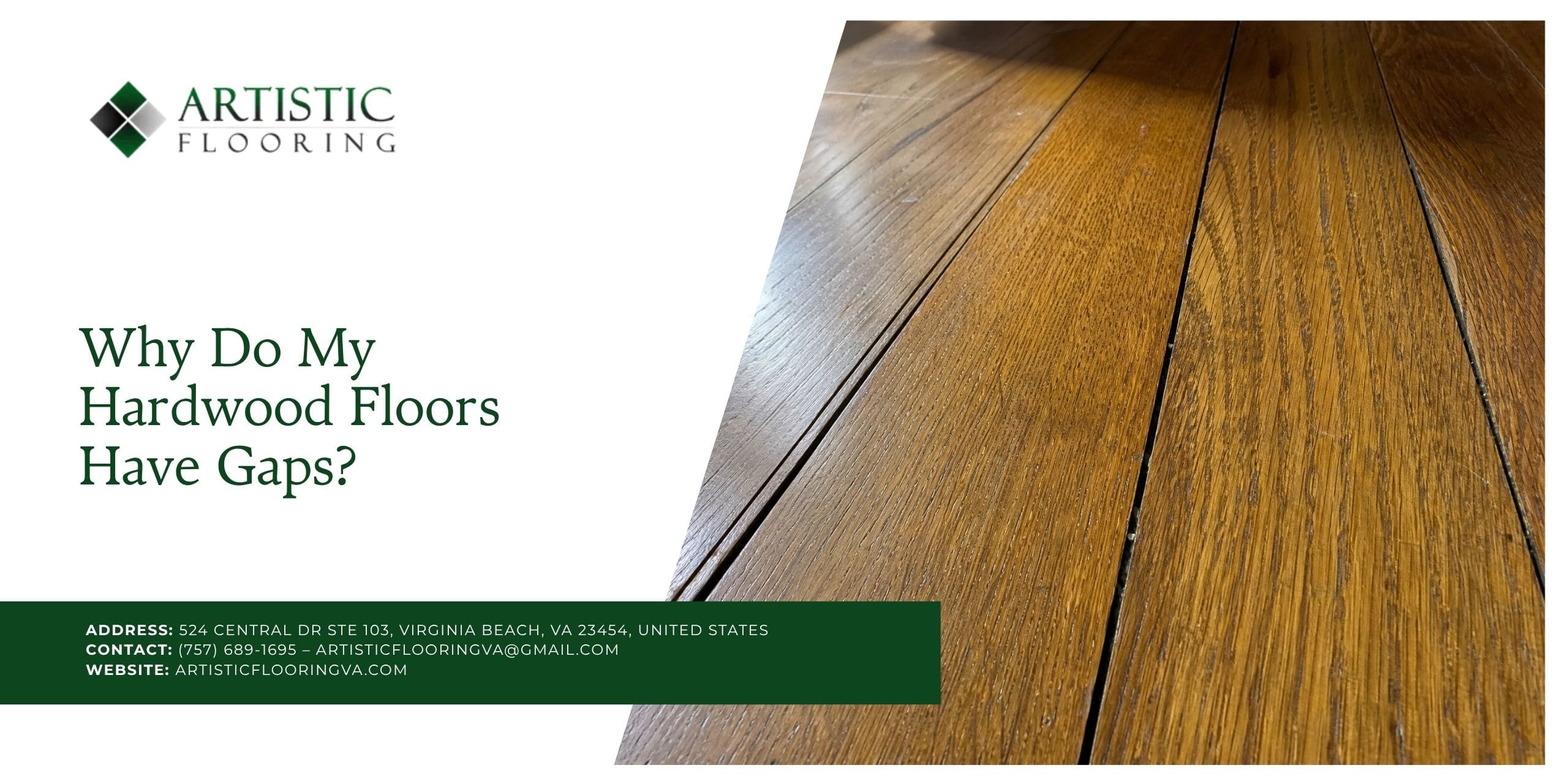
Ever walk across your hardwood floors and notice thin lines between the boards that weren’t there before? They could’ve been there last winter too. Ever since, you’ve probably been wondering if something is wrong. Gaps in hardwood floors are a common concern among Virginia Beach homeowners. Where do they come from? Moisture.
Generally, hardwood floor gaps are normal, but some aren’t. Knowing the difference matters, especially on the coast that experiences regular humidity swings.
At Artistic Flooring, we’ve been installing and refinishing hardwood floors across Virginia Beach, Chesapeake and Norfolk for over 30 years. Here’s what we tell homeowners when they call about gaps.
Table of Contents
ToggleWhy Does Wood Move?
Hardwood is a natural material. Even after it’s milled, dried, finished and installed in your home, it continues to respond to the moisture in the air around it. When the humidity rises, wood absorbs moisture from the air and expands. When humidity drops, wood releases moisture and contracts. The cycle never fully stops.
Because of this, your floor is always in motion. You can’t see it or feel it. That said, very dry winters and very humid summers cause cumulative movement across the width of every board in a room. The result is gaps between boards when the wood contracts and occasionally slight crowning or cupping when it expands.
It’s just how wood behaves.
Why Does Virginia Beach Make Gaps More Pronounced?
When it comes to hardwood floor maintenance advice, seasonal gapping is a minor seasonal nuisance. In Virginia Beach, you should take it seriously.
On the coast, humidity swings are more dramatic than inland climates. A dry stretch in January followed by a humid February followed by another dry snap in March puts hardwood through more contraction cycles in a single season than a floor in a drier market experiences all year. As time passes, repeated cycling stresses the wood fibers and the finish.
Virginia Beach homes are built on slab foundations. Slabs send ground moisture upward into the living space so the moisture affecting your hardwood floors isn’t just coming from the air, it’s coming from below. Moisture testing and subfloor prep are essential. That’s why it’s standard practice in every Artistic Flooring hardwood installation.
What is Normal Gapping and What Gapping Signals a Problem?
What type of gapping are you looking at? Seasonal gapping is completely normal for hardwood floors, but others gaps are not. Let’s discuss the difference.
Normal Seasonal Gapping
Here’s what normal seasonal gapping looks like:
- Gaps appear in winter or during dry periods and close back up in spring or summer
- Gaps are consistent and evenly distributed across the floor
- Gaps are narrow, typically no wider than the thickness of a quarter
- The floor feels stable and solid underfoot with no movement or flex
This gapping is a natural response to seasonal humidity changes. It’s not a sign of a defective installation or a damaged floor. Manage your indoor humidity by maintaining 35-55% relative humidity range year-round. It reduces how much your floors move between seasons.
Gaps That Warrant a Closer Look
Some gapping isn’t seasonal. Here’s when they’re worth a closer look:
- Gaps that appear suddenly rather than gradually with the seasons
- Gaps that don’t close back up when humidity returns
- Gaps that are wide (more than the thickness of a coin) that are growing over time
- Gapping accompanied by cupping, crowning, squeaking or boards that feel loose
- Gapping localized to one area of the floor rather than distributed evenly
These patterns are usually a sign of a moisture problem that goes beyond normal seasonal movement. The common culprits? Usually, it’s a subfloor issue, inadequate acclimation before installation or an HVAC or humidity management issue within the home.
Have gaps that concern you? Contact us for a hardwood floor assessment so we can identify if what you’re seeing is normal or needs attention.
What Role Do Acclimation and Installation Play?
Some gapping problems show up years later. Despite this, problems can originate at the time of installation or even before it.
Before installing it, hardwood flooring needs time to acclimate to the home. The process is letting the wood sit in the space open to the air at the home’s normal temperature and humidity before a single board is nailed down. Acclimation gives the wood time to adjust to its environment to reduce expansion and contraction post-installation.
Skipping acclimation can result in a floor installed at a moisture content that doesn’t match the home’s equilibrium. The result? Wood can move dramatically following installation, which produces gaps or cupping the homeowner attributes to a product defect when the real cause is an installation shortcut.
Proper subfloor preparation makes a difference. When a subfloor isn’t flat, dry or structurally sound, it puts more stress on the floor, accelerates movement and results in gapping humidity management can never fully correct.
These steps separate a hardwood installation that performs for decades from one that has problems within a few years. Unfortunately, many low-bid installers skip it.
What Can You Do About Seasonal Gapping?
If you’re experiencing seasonal gapping, here are the most effective things you can do to consistently manage indoor humidity:
- Use a Whole-Home Humidifier in Winter: Keep indoor humidity above 35% when heating systems dry out the air.
- Use Air Conditioning or a Dehumidifier in Summer: Keep humidity below 55% during Virginia Beach’s humid season.
- Avoid Dramatic Temperature Swings: Rapid changes in HVAC settings can result in faster moisture cycling in the wood.
- Use Area rugs in High-Traffic Zones: They buffer temperature and humidity fluctuations at the floor level.
Is seasonal gapping happening for the first time in a floor that’s been stable for years? Check if anything has changed in your home’s humidity management system. This could range from a humidifier that stopped working, a change in HVAC settings or a new source of moisture in the space.
When Should You Call a Professional?
The majority of seasonal gapping resolves itself. That said, if gaps don’t close, are widening or are accompanied by other symptoms like squeaking, soft spots, cupping or a different feeling underfoot, it’s worth having a professional from Artistic Flooring assess the situation. Catching moisture problems early is essential.
Want to know more about the gaps in your hardwood floors? Contact us to schedule an in-home consultation today!